
Transparency note: This post was written with the support of AI tools to help with drafting and clarity. All ideas, edits, and final wording reflect my own voice, my values and align with my therapeutic approach and professional standards.
There is a moment most of us recognize. You are in a meeting, or making dinner, or lying in bed at 5am, and something rises in your chest. Dread. Shame. A low-grade ache you cannot name. And the first instinct is to push it down, scroll past it, make it stop.
What if that instinct is costing you more than you realize?
Suppressing emotions costs us more than we think. Research consistently shows that pushing emotions down does not make them smaller, but makes them louder, longer, and harder to read. People who habitually suppress emotional expression report lower wellbeing, worse memory for emotional events, and more difficulty in close relationships. The emotion does not disappear, it just goes underground.
The practice of RAIN offers a different path. Grounded in neuroscience and developed through the mindfulness tradition, RAIN gives you a sequence that works with how the brain actually processes emotional experience.
What Is Actually Happening in the Brain
Before the steps, it helps to understand why emotions need a process at all.
Emotions are not events that happen to you. They are signals rising from the body, filtered through everything you have previously learned about what those signals mean. It is the brain's attempt to make sense of it.
The brain's alarm system fires before the thinking brain (prefrontal cortex) has a chance to catch up. The problem comes when the alarm never gets the all-clear signal, when there is no appraisal, no context, no meaning made and the body stays in a state of incomplete response, waiting for something to resolve.
Naming an emotion precisely and identifying the feeling itself measurably reduces the brain's threat response and brings the thinking, regulating part of the brain back online. The more specific the label, the greater the effect. This is why "I feel bad" doesn't do what "I feel humiliated" does. The precision is the medicine.
There is also a body layer that purely cognitive approaches miss. Emotions are not just mental states, they are physical action programs. When something threatening or overwhelming happens, the body organizes to respond: to fight, flee, collapse, protest. When that response is interrupted, because the situation didn't allow it, or because it wasn't safe, the impulse doesn't disappear. It stays encoded in the tissue as tension, bracing, or numbness. Real processing requires going back to the body to find what was never finished.
The last piece is often the most overlooked: understanding a feeling is not the same as completing it. The stress response has a beginning, a middle, and an end and the body needs to move through all three. Without that physiological resolution, the emotion keeps cycling back. It is the body still looking for its ending.
The Four Steps of RAIN
RAIN was developed by Michele McDonald and later expanded by psychologist and meditation teacher Tara Brach, whose writing and guided practices have brought this framework to a wide clinical and lay audience.
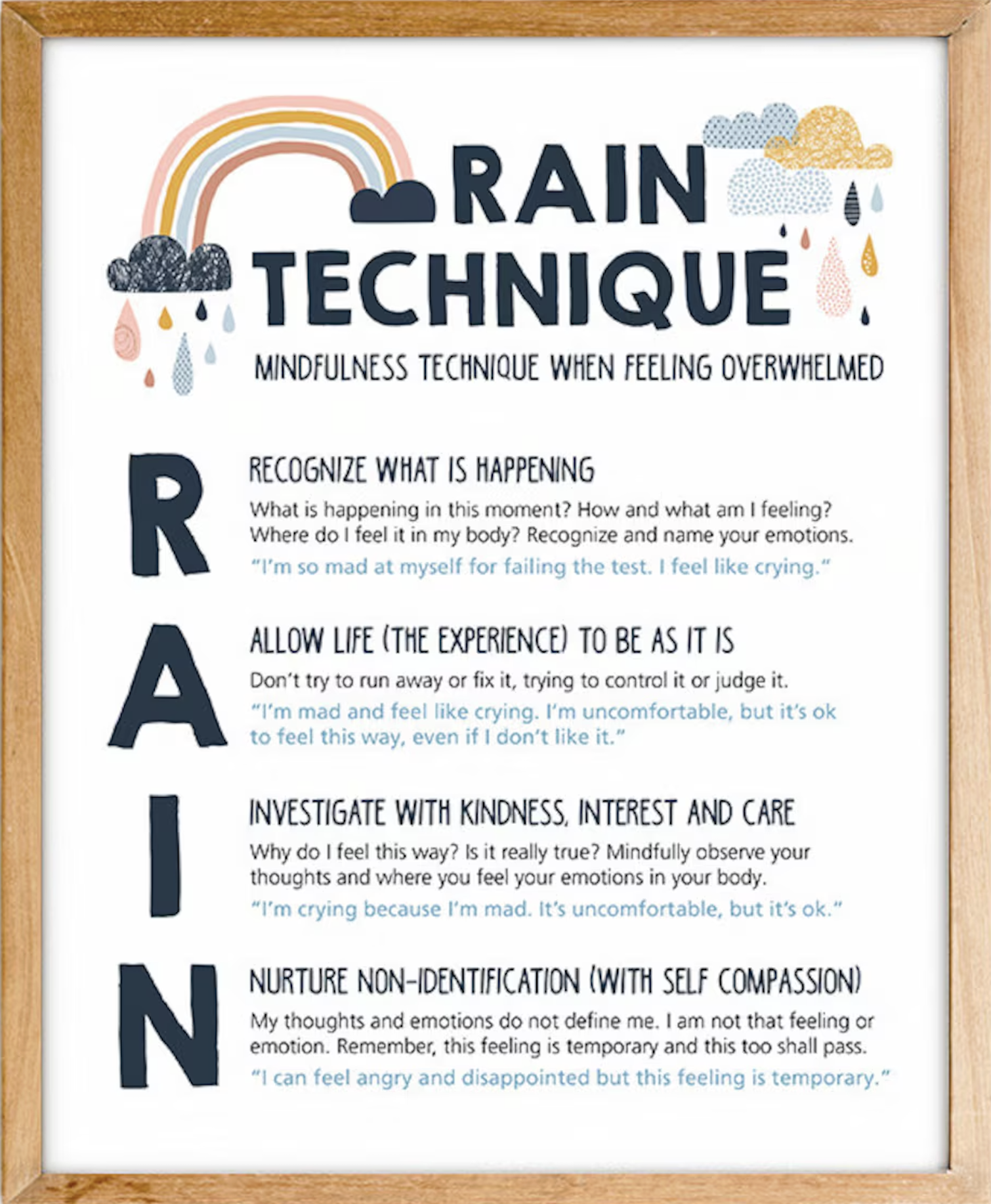
RAIN Technique Summary
R — Recognize
The first step is recognize and simply notice that something is happening, just to acknowledge: there is a feeling present right now.
This matters more than it sounds. Most of us move through emotional experience on autopilot, reacting without ever pausing to register what is actually there. Recognition interrupts that automaticity. It is the moment of waking up inside the experience rather than being dragged by it.
Try: “Something is here. I am noticing something in my body right now.”
A — Allow
Allowing means letting the feeling be present without immediately trying to fix, suppress, or justify it. This is not the same as approval or resignation. The resistance to a difficult emotion is often as costly as the emotion itself. Allowing creates just enough space for the nervous system to begin settling.
Stephen Porges’ polyvagal research helps us understand why: the ventral vagal state — the one associated with safety and social engagement — is a prerequisite for any genuine emotional processing. You cannot process what you cannot tolerate being near.
Try: “I don’t have to fix this right now. I can let it be here.”
I — Investigate
Investigation is where the science gets specific. This step asks you to turn toward the feeling with curiosity, particularly in the body. Not “why do I feel this?” (which pulls you into narrative), but “where is this in my body, and what does it want to do?”
That second question matters. Peter Levine’s research shows that emotions carry motor impulses: the chest that wants to push something away, the throat that wants to cry out, the legs that want to run. These are not metaphors but incomplete biological responses. Asking what the sensation wants to do begins to surface that impulse, which is the first step toward allowing it to complete.
The insula, the brain region that tracks body signals and passes them to conscious awareness, is more active during this kind of deliberate interoceptive attention. For people with trauma histories or difficulty identifying emotions (alexithymia), this step can feel unfamiliar or blank at first. That is information that the channel is simply less practiced.
Try: “Where do I feel this? What does the sensation in my body want to do, if it could do anything?”
N — Nurture
The final step is to offer yourself something in response to what you have found and nurture it. A hand on the chest. A breath. An internal acknowledgment: this makes sense. This is hard. I am here.
Kristin Neff’s research on self-compassion shows that this kind of self-directed warmth activates the caregiving system. The same neurological circuitry involved in caring for others. It reduces cortisol, lowers self-critical rumination, and increases the capacity to stay with difficult experience rather than flee it.
Tara Brach describes the N as “not-identifying” — recognizing that you are not the same as the feeling, that there is an awareness larger than any particular emotional state.
Try: “What does this part of me need right now? What would I say to someone I loved who was feeling this?”
After the Rain
RAIN does not end the emotion. What it does is complete the cycle. Research is clear that the stress response has a beginning, middle, and end and that the body needs to move through all three. Physical movement, breath, and even brief moments of connection can all help the nervous system close the loop.
After moving through the four steps, it often helps to do something physical: a walk, shaking out the hands, several slow exhales where the out-breath is longer than the in-breath, which activates the parasympathetic branch of the nervous system). This is not separate from the emotional work but is the final stage of it.
Research on expressive writing offers another route: writing about a difficult emotional experience for fifteen to twenty minutes, without editing, just following the thread, produces measurable improvements in immune function, mood, and clarity over time. The act of forming language around experience does something that thinking alone does not.
What This Looks Like in Daily Life
You do not need a meditation cushion to practice RAIN. You need a moment and a willingness to pause.
When something difficult rises — in a conversation, in the car, in the middle of the night — you can run through the sequence in sixty seconds. Recognize that something is there. Allow it to be present without immediately acting. Investigate where it lives in your body. Nurture whatever you find.
The more precise the emotional label in the first step, the more effective the practice. Not “I feel bad” but “lonely” or “humiliated” or “anxious about being left out.” Research on emotional granularity shows that people who can make finer distinctions between emotional states regulate more flexibly and recover more quickly from difficulty. The name is not a cure but it is the beginning of the cure and the moment the nervous system has enough information to start settling, and the mind has enough space to begin making sense of what happened.
A Note on When This Is Hard
For some people, turning toward an emotion does not feel safe. If there is a trauma history, a history of being told that feelings were too much or simply wrong, or a pattern of dissociation, RAIN can feel disorienting or even activating. It is a signal that the window of tolerance, the zone in which the nervous system can process without flooding, needs to be widened first.
This is where working with a therapist becomes useful. The steps of RAIN can be practised slowly, with support, in a relationship that provides enough safety to make the investigation possible.
Try It Now
If you want to experience RAIN directly, Tara Brach offers a guided audio practice through Mindful.org. It takes about fifteen minutes and walks you through each step with care.
Listen here: Tara Brach: RAIN Mindfulness Practice
You can also begin more simply: the next time something difficult arises, pause for sixty seconds. Put a hand on your chest. Find one word for what is there. That is enough to start.
Sources
Brach, T. Radical Compassion. Viking, 2019.
Neff, K. Self-Compassion: The Proven Power of Being Kind to Yourself. William Morrow, 2011.
Porges, S.W. The Polyvagal Theory: Neurophysiological Foundations of Emotions, Attachment, Communication, and Self-Regulation. Norton, 2011.
Torre, J.B. and Lieberman, M.D. Putting Feelings Into Words: Affect Labeling as Implicit Emotion Regulation. Emotion Review, 10(2), 116–124, 2018.